How AI Adjusts Heat for Perfect Multi-Zone Cooking
Learn how AI uses sensors and real-time heat redistribution to manage multiple oven zones, ensuring even cooking, faster meals, and precise temperature control.

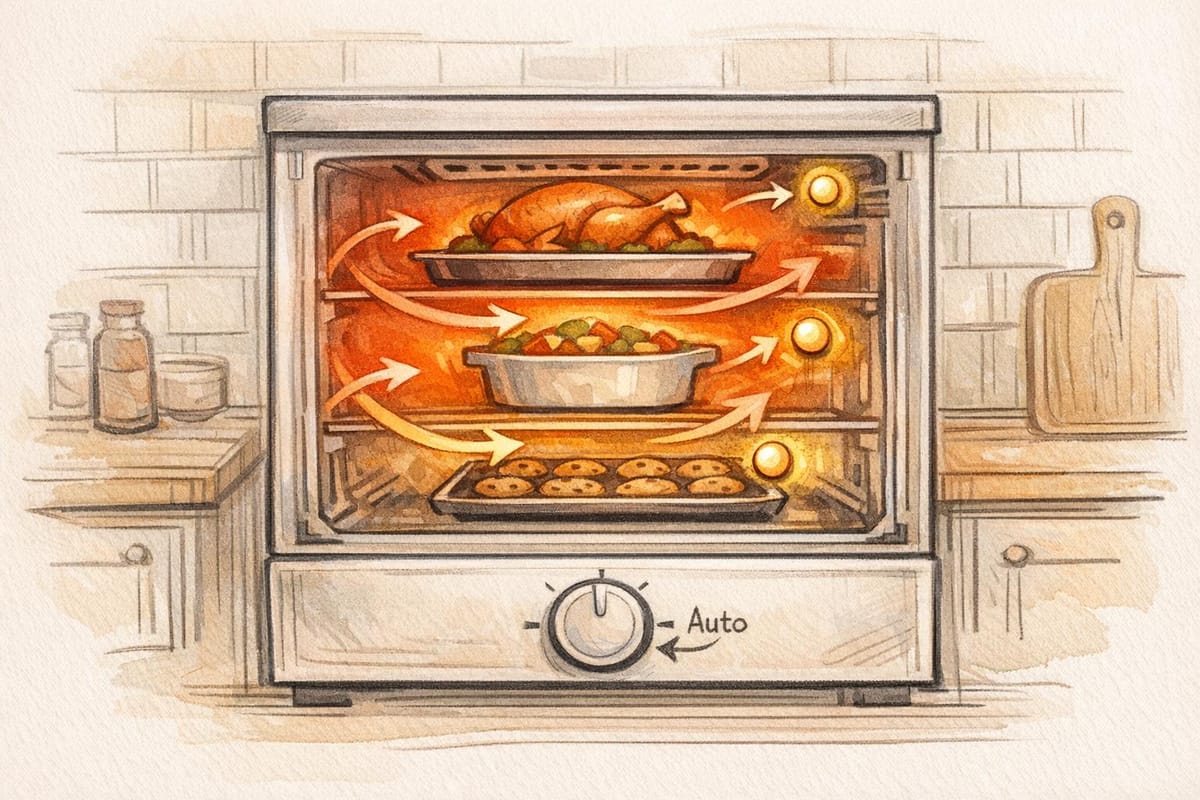
Cooking multiple dishes at once just got easier. AI-powered multi-zone cooking divides your oven, cooktop, or air fryer into separate temperature zones, letting you cook different foods simultaneously with precision. By using sensors to monitor temperature, moisture, and food thickness, AI adjusts heat in real time, ensuring even cooking and reducing errors.
Key Benefits:
- Time-Saving: Cuts cooking time by up to 30%.
- Precision: Maintains temperature within ±0.8°F for consistent results.
- Convenience: Syncs recipes from apps like Honeydew Recipe Manager to automate cooking steps.
AI systems like Honeydew also simplify meal planning and ingredient prep, track nutrition, and manage grocery lists, making cooking smarter and more efficient.
What is Multi-Zone Cooking and AI Heat Redistribution?
Multi-Zone Cooking Explained
Multi-zone cooking allows a single appliance to operate with multiple temperature zones, enabling you to cook dishes requiring different heat levels at the same time. Whether it’s an oven, cooktop, or air fryer, this feature helps streamline meal preparation.
In ovens, this is often referred to as "vertical zoning." For example, the top shelf is great for browning or crisping since heat reflects off the roof, the middle shelf ensures even baking with steady air circulation, and the bottom shelf is perfect for searing or roasting, being closest to the heating element. On cooktops, "bridging" technology lets you combine two smaller induction zones into one larger zone, making it ideal for oversized cookware like griddles. Air fryers with dual drawers take it a step further by using "Sync" technology to delay cooking times for quicker dishes, ensuring everything finishes together.
| Appliance Type | Multi-Zone Method | Primary Benefit |
|---|---|---|
| Oven | Vertical shelf positioning | Cook multiple dishes with different heat needs simultaneously |
| Cooktop | Bridging zones | Seamlessly handle large cookware and varied heat levels |
| Air Fryer | Dual-drawer "Sync" technology | Perfectly timed completion of all dishes |
These distinct zones create the foundation for AI-driven systems to take cooking precision to the next level.
How AI Adjusts Heat in Real Time
With the multi-zone setup in place, AI technology steps in to fine-tune heat distribution dynamically. Using tools like 3D thermal mapping and sensors that measure food thickness and internal temperature, AI ensures even heat delivery across all zones. This prevents overcooking or undercooking while maintaining optimal conditions for each dish. Some advanced appliances even reposition infrared burners to guarantee heat reaches every part of the food, including the edges.
In a breakthrough study from November 2025, researchers unveiled the Software-Defined Cooking (SDC) system. This system used RF-powered neon lights and fiber-optic cables to boost thermal uniformity by 633%, handling temperature differences of up to 329°F across just 1.2 inches. AI enhances this process by adjusting heat every 8–12 seconds, compensating for changes in ambient temperature and ensuring each dish is cooked to perfection. Together, these innovations make multi-zone cooking smarter and more precise than ever.
Technologies That Enable AI Heat Adjustment
Sensors and Data Collection
AI-driven multi-zone cooking relies heavily on sensors to gather real-time data from your appliance. For example, core temperature probes track the internal heat of your food. Systems like the iVario Pro can even monitor up to four separate items simultaneously across different heating zones, ensuring precise control. Meanwhile, surface-level sensors, positioned directly beneath the cooking surface, provide accurate readings for tasks like searing or flipping.
Environmental sensors play a crucial role in adjusting to changes within the cooking cavity. If you open the oven door and heat escapes, these sensors quickly detect the drop and prompt the system to compensate. Moisture sensors, on the other hand, monitor steam levels and adjust cooking time and power as water evaporates from your food. Chef Owen, Culinary Director at Hestan Cue, describes how this technology works in practice:
"The Smart Probe is constantly regulating our cooking medium... It works with the Cue App and Cue Smart Induction Cooktop to make sure the oil recovers temperature when adding cold ingredients as well as making sure that our oil doesn't get too hot".
These sensors and smart probes communicate wirelessly with heating elements, enabling precise, real-time energy adjustments. This seamless flow of data provides the foundation for AI algorithms to fine-tune heat distribution with remarkable accuracy.
AI Algorithms and Machine Learning
Once sensor data is collected, AI algorithms take over to manage heat distribution across cooking zones. These systems analyze temperature fluctuations and moisture levels to calculate the exact heat each zone requires. Some devices even incorporate computer vision technology to detect cookware placement, further optimizing heat delivery. Features like CookTimeCorrection (CTC) ensure consistent cooking by compensating for heat loss from door openings or unexpected temperature changes, all without requiring manual input.
Machine learning adds another layer of intelligence by adapting to user behavior over time. Siemens Home highlights this capability:
"Our networked appliances will learn with each use, recognize your preferences and wishes – and adjust to them automatically".
Advanced roasting sensors take precision a step further by measuring internal food temperatures at three distinct points, ensuring heating stops exactly when your target temperature is reached. Tools like Honeydew Recipe Manager showcase how AI systems modulate power to heating elements every 8–12 seconds, predicting heat needs and adjusting energy output before temperatures exceed preset limits. This level of thermal control outperforms manual adjustments, delivering consistent results every time.
How AI Heat Redistribution Works in Practice
Heat Redistribution Methods
AI-based systems use physical techniques to manage heat distribution with remarkable precision. For example, automated airflow control adjusts convection fan speeds every 8–12 seconds. This can slow down to retain moisture or speed up to enhance browning, depending on the cooking requirements. Another method, reflective energy steering, uses microwave-safe metallic spheres or adjustable shields to protect delicate ingredients from overcooking while directing more energy to thicker portions. These techniques lay the groundwork for even more sophisticated innovations.
Some systems take it a step further with programmable actuation. This involves moving food on a step-motor-controlled turntable to address hot or cold spots, ensuring optimal heat distribution. A notable example from November 2025 involved researchers modifying a Sharp SMC1441CW microwave with neon lamp arrays and fiber-optic cables. This setup sensed electromagnetic field strength in real time and performed discriminative heating - cooking different parts of food to distinct temperatures. For instance, it cooked bacon by treating the meat and fat separately, achieving ideal textures for each. These breakthroughs not only fine-tune heat distribution but also enhance overall cooking precision. Commercial ovens like Invoq incorporate similar advancements, using intelligent sensors to detect heat loss when doors are opened and automatically adjusting heat levels for each rack.
Improved Cooking Precision with AI
Building on these heat management methods, AI systems deliver unmatched cooking accuracy. Software-defined cooking (SDC) enhances thermal uniformity by 633% and refines temperature control to a variance of just ±0.8°F. This is a significant improvement compared to the ±4.3°F variations seen with manual adjustments. AI systems can also create temperature differences of up to 361°F (183°C) within a spatial resolution as precise as 3 cm.
In a 2026 study involving 48 roasts, a hybrid approach - combining AI presets with minor human adjustments - achieved the most consistent results. It maintained a variance of just ±0.6°F in the thigh core temperature, limited moisture loss to 19.4%, and delivered superior skin crispness compared to either AI-only or manual-only methods. This level of control minimizes the need for constant monitoring and significantly reduces the chances of overcooked edges or undercooked centers.
"Algorithms optimize for averages. Cooking is about outliers - the bird with uneven fat, the oven with a cold spot, the day your humidity is 85%."
Chef Lena Torres, a James Beard Award–winning instructor, highlights this balance. Such precision is seamlessly integrated into platforms like Honeydew Recipe Manager, which offers users real-time temperature control for consistently flawless results.
Benefits of AI Multi-Zone Cooking with Honeydew Recipe Manager
Simplified Meal Planning and Cooking
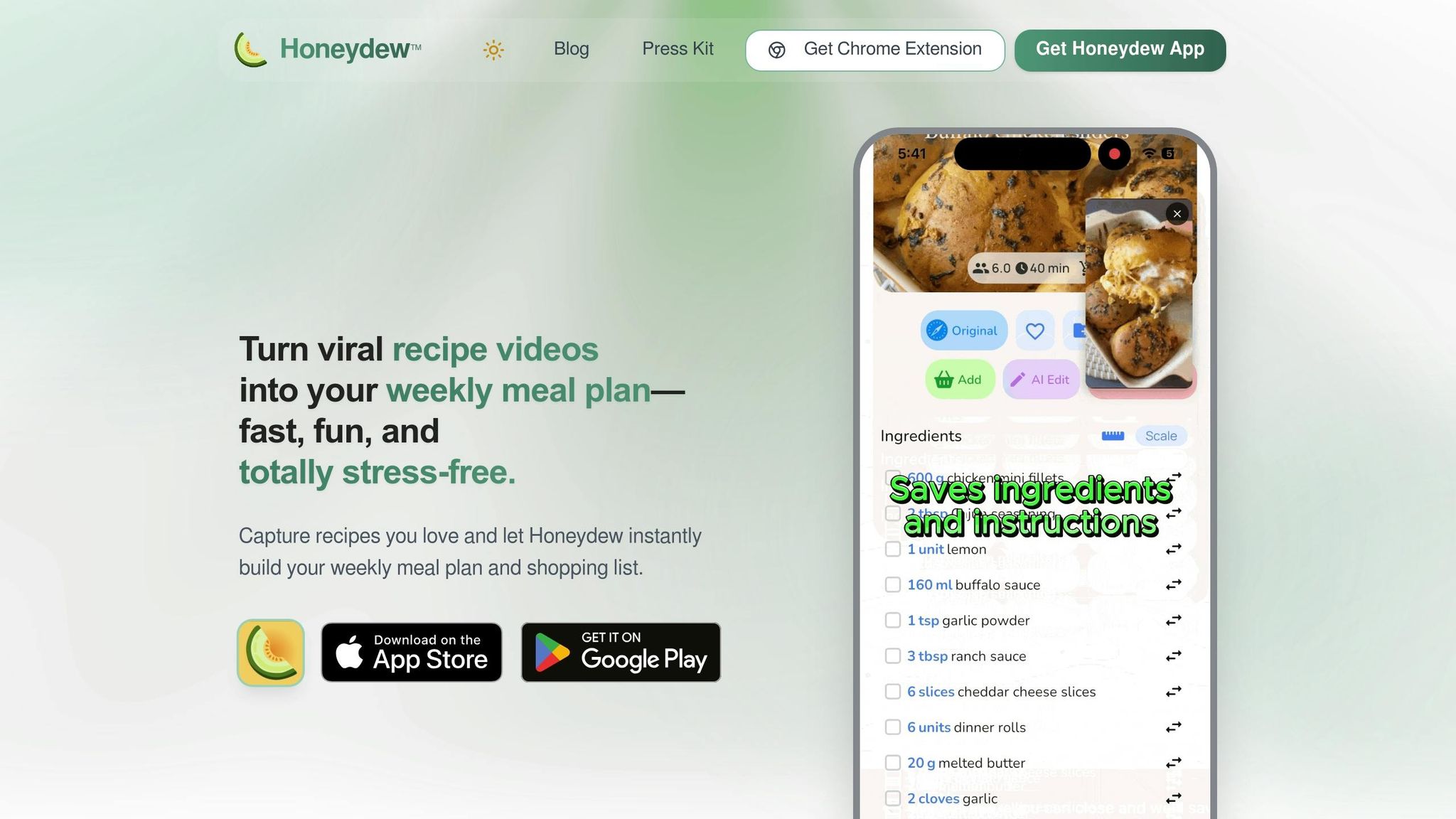
The Honeydew Recipe Manager takes the hassle out of meal prep by connecting online recipes with AI-powered precision cooking. Found a recipe on TikTok, Instagram, or YouTube that you’re dying to try? The app can import it directly, breaking it down into clear, digital recipe cards with all the ingredients, measurements, and steps neatly formatted.
Once imported, you can sync these recipes with your AI-enabled smart oven. The app handles everything - from preheating to monitoring progress and managing multi-zone heat transitions. With Honeydew, even complex recipes with varying cook times and temperatures are automatically converted into smart instructions your appliances can follow. On top of that, its AI meal planner creates personalized weekly menus based on your dietary needs (like Keto, Vegan, or Low FODMAP) and pantry stock. It even generates grocery lists, sorted by aisle, and integrates with Instacart for easy shopping. This all-in-one approach not only saves time but also lays the groundwork for detailed nutritional tracking.
Nutrition Tracking and Precision Cooking
Honeydew Recipe Manager doesn’t just make cooking easier - it also helps you stay on top of your health goals. The app automatically tags recipes with nutritional details, including calorie counts per serving, so you can make informed choices. When scaling recipes with its portioning tool, it adjusts seamlessly between Imperial and Metric units. Even better, your AI-enabled oven recalibrates heat distribution to match the exact quantity of food, ensuring consistent results every time.
"The calorie and macro calculator has helped me stick to my health goals while still enjoying great meals." - Michael B., Verified User
Gone are the days of guesswork. With Honeydew, every meal is cooked with precision and aligned with your goals.
Honeydew Plus Features for Advanced Users
For those looking to take their cooking to the next level, Honeydew Plus offers a range of premium features for $4.17/month or $39.99/year. Subscribers enjoy unlimited recipe imports, allowing them to build a digital cookbook without limits. Advanced meal planning includes seasonal ingredient suggestions and leftover management, helping to minimize food waste. The household sharing feature supports up to six members, making it easy to sync meal plans and grocery lists across the family.
Other perks include a cookbook translator for international recipes, smart ingredient substitutions when something’s missing, and an ad-free experience. Plus, Honeydew works offline, so even if your Wi-Fi cuts out mid-cook, you’ll still have access to your recipes and instructions.
wan AIChef Ultra cooking system: chef mode, temperature control, $3,999 US launch
How to Use AI Multi-Zone Cooking: Step-by-Step Guide
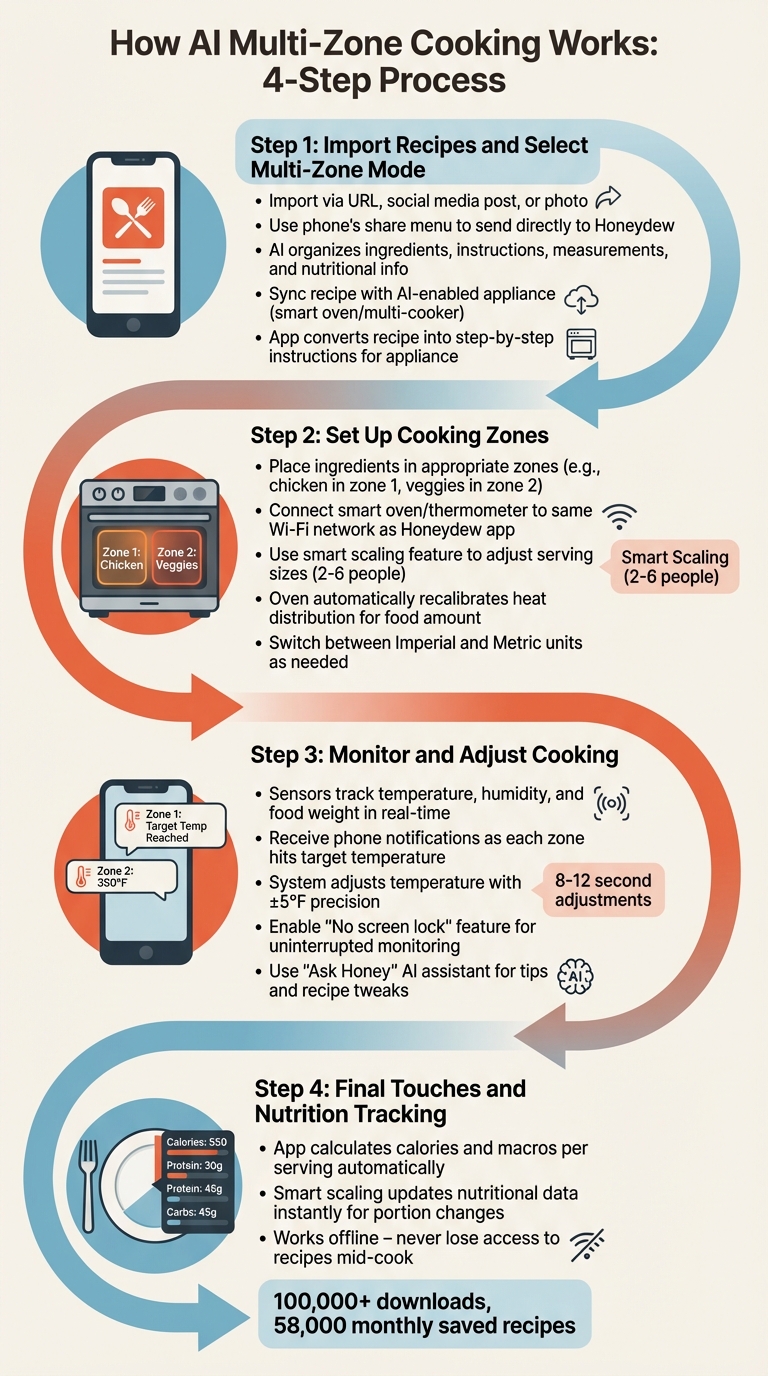
How AI Multi-Zone Cooking Works: 4-Step Process with Honeydew Recipe Manager
Step 1: Import Recipes and Select Multi-Zone Mode
Start by bringing your recipe into the Honeydew Recipe Manager. You can do this through a URL, a social media post, or even by snapping a photo of the recipe. The easiest method? Use your phone's share menu while browsing social media - just tap the share icon and send the recipe directly to Honeydew.
Once the recipe is imported, the app’s AI gets to work. It organizes everything - ingredients, instructions, measurements, and nutritional info - into a neat digital recipe card. From there, sync the recipe with your AI-enabled appliance, like a smart oven or multi-cooker. The app converts the recipe into step-by-step instructions that your appliance can follow, taking care of preheating, timing, and heat management. All you need to do is set up the cooking zones according to the recipe.
Step 2: Set Up Cooking Zones
After syncing, place your ingredients in the appropriate zones of your smart appliance. For example, chicken breasts might go in zone one, while your veggies are set up in zone two. Make sure your smart oven or thermometer is connected to the same Wi-Fi network as the Honeydew app. This connection allows the AI to manage heat distribution and monitor cooking in real time.
Before starting, you can use the app’s smart scaling feature to adjust serving sizes. Whether you’re cooking for two or six, the oven recalibrates heat distribution automatically to match the amount of food, ensuring everything cooks evenly. You can also switch effortlessly between Imperial and Metric units if needed.
Step 3: Monitor and Adjust Cooking
As the cooking process begins, sensors in the appliance track temperature, humidity, and even the weight of your food. You’ll get notifications on your phone as each cooking zone hits its target temperature. The system uses advanced predictive models to fine-tune the temperature with adjustments as precise as ±5°F.
For uninterrupted monitoring, enable the "No screen lock" feature in the app. Need advice while cooking? Use the "Ask Honey" AI assistant for quick tips or to tweak the recipe with voice or text commands. This keeps the process smooth and stress-free.
Step 4: Final Touches and Nutrition Tracking
As your meal wraps up, the Honeydew app shifts to the finishing steps, including detailed nutrition tracking. It calculates calories and macros per serving automatically, helping you stay aligned with your health goals. If you need to tweak portion sizes at the last minute, the app’s smart scaling tool updates the nutritional data instantly, ensuring accuracy in measurements like cups, ounces, and Fahrenheit temperatures.
With over 100,000 downloads and 58,000 monthly saved recipes, Honeydew Recipe Manager has become a trusted tool for precision cooking. Even better, the app works offline, so you’ll never lose access to your recipes or instructions - even if your Wi-Fi cuts out in the middle of cooking.
Conclusion
AI-powered multi-zone cooking is reshaping home kitchens, bringing restaurant-level precision to everyday meals. By using real-time sensor data and predictive algorithms, these systems eliminate the guesswork, ensuring perfectly cooked dishes without requiring constant attention.
One standout example of this technological leap is the Honeydew Recipe Manager. This tool simplifies meal planning while optimizing heat distribution. It enables users to import recipes directly from social media, sync them with smart appliances, and make real-time adjustments for both cooking and nutrition tracking.
"This AI-powered cooker is a game-changer for the culinary industry. It's not just about reheating leftovers – it's about unlocking a whole new level of cooking precision and efficiency that we've never seen before in a home appliance."
- Sarah Johnson, Culinary Analyst
The growing trust in this technology is evident. Sales of AI-integrated cooking appliances jumped by 120% in the first quarter of 2025 alone, signaling a major shift in how people approach cooking at home.
FAQs
Do I need special cookware for multi-zone cooking?
Special cookware can make a big difference when it comes to multi-zone cooking, especially if you're using induction or smart cooking systems. Materials like cast iron or multi-layer stainless steel are popular choices because they tend to distribute heat more evenly and offer reliable safety. Some advanced appliances are designed to work only with specific types of cookware, so it's a good idea to review your system's compatibility guidelines to get the best performance.
How does AI prevent one zone from affecting another zone’s temperature?
AI uses sensors, cameras, and algorithms to monitor each cooking zone separately, ensuring they don't interfere with one another. It fine-tunes temperature, humidity, and cooking stages in real time, offering precise control and ensuring consistent results every time.
Will AI multi-zone cooking still work if my Wi‑Fi drops?
AI multi-zone cooking appliances can still function even if your Wi-Fi goes out. Most devices include manual controls or onboard buttons for essential operations. That said, advanced options, like controlling the appliance remotely, typically depend on having an active internet connection.